

Short answer: there is no responsible single price for an e-commerce website in Egypt in 2026. The budget is shaped by the number and complexity of products, design depth, payment and delivery connections, language requirements, content quality, security, hosting, and the amount of custom business logic. A small catalog using a well-supported WooCommerce setup can have a very different scope from a marketplace, a multi-warehouse store, or a custom commerce platform. The useful first step is therefore to define the operation you need, then request an estimate against that scope.
By SPOTMEDIA. This editorial guide explains the decisions behind an estimate; it is not a published price list or a promise of a particular sales result.
Key takeaways
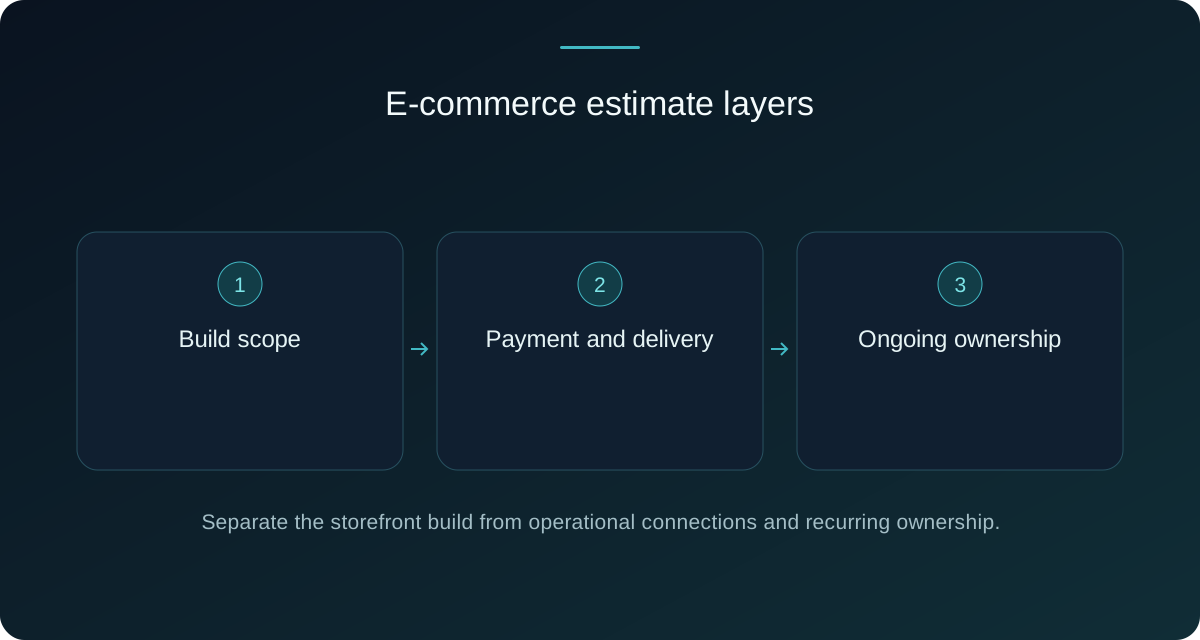
- Separate one-time work from recurring costs such as hosting, payment-provider charges, extensions, support, and content updates.
- WooCommerce is often a sensible starting point when the catalog and workflow fit established commerce patterns. Custom development is more appropriate when rules, integrations, roles, or scale cannot be handled cleanly by configured components.
- Payment and shipping are not just buttons on a product page: they require an operational agreement, reliable status handling, testing, and clear customer communication.
- Ask for an itemised scope rather than comparing a headline number. A lower initial estimate can omit migration, Arabic content, product data, QA, training, or maintenance.
- The right estimate begins with a short discovery of products, orders, fulfilment, integrations, content, and success criteria.
What the cost of an e-commerce website covers
An online store is a customer-facing interface connected to an operational system. A useful proposal should say which parts are included, which are supplied by the business, and which remain recurring services. The following layers are a practical way to read an estimate.
Discovery and information architecture
Before screens are designed, the team needs to understand the catalog, product attributes, variants, stock rules, order states, returns, user roles, delivery zones, and reporting needs. A store selling ten standard products has a different information architecture from one selling thousands of products with filters, bundles, subscriptions, or configurable items. Mapping these rules early reduces rework and exposes integration questions.
Design, content, and product data
Design includes the storefront structure, responsive layouts, navigation, product detail page, cart, checkout, account area, search, and error states. It may also include a visual direction and reusable components. Content work can include product photography supplied by the business, descriptions, attributes, category copy, policies, Arabic and English versions, and import or cleanup of an existing catalog. A visually polished site cannot compensate for incomplete product data or unclear delivery and return information.
The commerce engine
The platform stores products, customers, orders, stock and promotions. WooCommerce extends WordPress with familiar commerce capabilities and a broad extension ecosystem. A custom build can model unusual rules directly, but it also makes the team responsible for more of the administration, permissions, testing, upgrades and long-term maintenance. Platform choice should follow the operating model, not a preference for a technology label.
Payments, delivery, and notifications
Payment integration may involve card processing, bank or wallet options, cash on delivery, refunds, failed transactions, reconciliation, and secure hand-off to the provider. The exact provider and eligibility depend on the business relationship and the provider’s current requirements; they should be confirmed rather than assumed in a proposal. Delivery integration may include zones, rates, pickup, tracking, delivery status, and a process for unavailable addresses. Email, SMS, or messaging notifications should have explicit ownership and fallback handling.
The main factors that change an estimate
Instead of asking only how many pages a store has, examine the variables below. Each one can affect design, development, testing, or ongoing care.
| Scope area | Questions to answer | Why it changes the work |
|---|---|---|
| Catalog | How many products, variants, categories, attributes, and images? | More data increases import, search, filtering, content, and QA effort. |
| Checkout | Which payment methods, currencies, addresses, taxes, refunds, and guest rules? | Each rule needs configuration, failure handling, and test cases. |
| Fulfilment | Which delivery zones, carriers, pickup options, tracking and return states? | Operations need reliable status mapping instead of a static shipping label. |
| Languages | Is the catalog bilingual, and who owns translation and future edits? | Arabic layout, content workflow, URLs, metadata and QA add scope. |
| Integrations | Must the store connect to ERP, CRM, accounting, warehouse or marketplace tools? | Data ownership, authentication, sync frequency and failure recovery must be defined. |
| Business rules | Are there subscriptions, bundles, wholesale roles, approvals or complex promotions? | Non-standard rules may require custom modules and deeper regression testing. |
| Ownership | Who manages hosting, updates, product entry, backups and support after launch? | Ongoing responsibility affects architecture and the handover plan. |
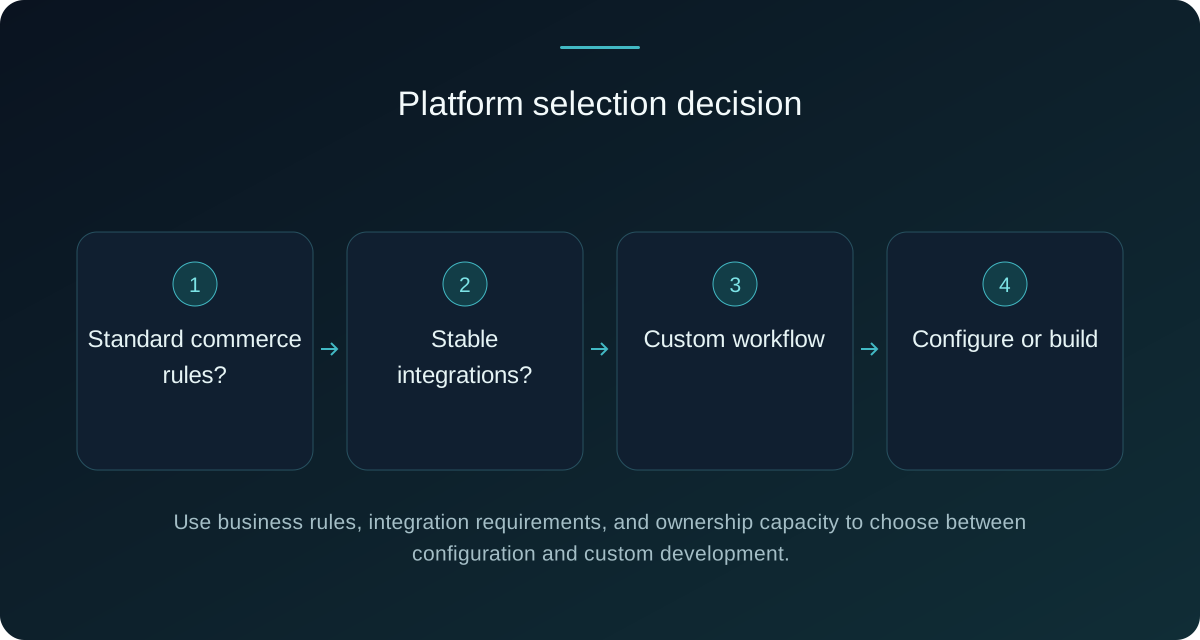
WooCommerce or custom e-commerce?
Neither option is automatically cheaper or better. WooCommerce can reduce the amount of foundational commerce functionality that must be built, while custom development can provide a cleaner fit for a distinctive workflow. The trade-off is not simply licence cost; it includes implementation, extensions, governance, performance, security, change management and the capabilities of the people who will own the store.
| Decision question | WooCommerce may fit when… | Custom development may fit when… |
|---|---|---|
| Catalog and checkout | Products, variants, promotions and checkout follow well-understood patterns. | The buying flow or pricing rules are unusual and central to the business. |
| Administration | The team wants a familiar content and product management workflow. | Multiple roles, approvals or operational screens need a purpose-built experience. |
| Integrations | Required providers have stable, compatible extensions or APIs. | Core systems require tightly controlled, two-way data flows and custom rules. |
| Growth | Expected growth can be handled with disciplined hosting, caching and extension choices. | Traffic, order volume, catalogue complexity or regional operations require a dedicated architecture. |
| Ownership | The business can maintain updates and keep the extension set small and reviewed. | The business has a technical owner for releases, monitoring and bespoke maintenance. |
Questions that matter for an Egyptian store
A store serving customers in Egypt should make local operating assumptions explicit. The exact answer depends on the merchant, provider and product category, so these are discovery questions rather than universal rules.
- Currency and language: Decide whether prices, policies, transactional messages and support are presented in Arabic, English, or both. Test right-to-left product details and checkout fields, not only the navigation.
- Payment readiness: Confirm the selected provider’s onboarding, settlement, refund and test environment requirements. Do not treat a provider logo as proof that a live account or every payment method is available.
- Cash and delivery: If cash on delivery is offered, define confirmation, address verification, cancellation, delivery fees and the order state after a failed attempt. If a carrier is integrated, agree who owns tracking exceptions.
- Product and policy information: Publish accurate stock status, delivery coverage, returns, exchanges, warranties and contact channels. Clear information is both a customer-service tool and a trust signal.
- Data and access: Use least-privilege administrator accounts, backups and a documented process for changing credentials. Review what personal data is collected and how it is retained with the relevant legal and operational advisers.
- Analytics: Decide which events are useful, such as product views, add-to-cart, checkout start, purchase, refund and search. Measurement should answer business questions and respect the applicable consent and privacy requirements.
Hypothetical planning scenarios
Hypothetical scenario: a focused catalog
Imagine a retailer with a focused catalog, one language at launch, standard product variants, a single delivery workflow and an established payment provider. The sensible brief would prioritise product data, mobile storefront, search, checkout reliability, order administration, policies, analytics and a clear handover. It would not need marketplace functions simply because those functions exist in a larger platform.
Hypothetical scenario: bilingual operations with integrations
Now imagine a growing business with Arabic and English catalogs, several delivery zones, stock held in more than one location, a CRM, promotions for customer segments and an accounting workflow. The estimate must include translation ownership, stock and order synchronisation, role permissions, exception handling, integration monitoring and a larger test matrix. Calling both projects a ten-page website would hide the work that makes the second operation dependable.
How to evaluate a proposal
SPOTMEDIA can discuss the scope with a business before an estimate is prepared. A useful evaluation approach is to review the current catalog and order journey, map customer and staff roles, list the payment and fulfilment dependencies, identify language and content requirements, and separate launch essentials from later improvements. The resulting brief should make assumptions visible and mark any dependency that the merchant must obtain, such as a provider account, product imagery, policy text or system access.
Compare proposals by deliverables and ownership, not just by a total. Check whether each one states the platform, integrations, data migration, responsive design, accessibility considerations, QA, deployment, training, documentation, backups, support boundaries and change-request treatment. Ask how a failed payment, unavailable product, duplicate webhook, lost delivery update or rollback would be handled. These questions reveal whether the estimate describes a working operation or only a set of screens.
Launch and ownership checklist
- Approve the catalog structure, product fields, images, variants and stock source.
- Test Arabic and English content, right-to-left layout, search, filters, cart and checkout on representative phones and desktops.
- Run payment success, cancellation, timeout, refund and duplicate-notification tests in the available test environment.
- Verify delivery zones, fees, address validation, tracking messages, returns and customer-support escalation.
- Confirm administrator roles, strong credentials, backups, update responsibility, monitoring and recovery contacts.
- Review titles, descriptions, canonical URLs, product information and structured-data eligibility with an SEO specialist. Google describes product structured data in its Search Central product documentation; it should be implemented accurately, not used to imply guaranteed visibility.
- Document who can change prices, stock, payment settings, extensions and production code after launch.
Frequently asked questions
Can you give one exact e-commerce website price for Egypt?
No. An exact figure without the catalog, checkout, delivery, integrations, languages and ownership requirements would be guesswork. A scoped estimate can be useful once those assumptions are recorded. Be cautious of a number that does not say what happens to product entry, payment setup, migration, QA, hosting and post-launch support.
Is WooCommerce always the least expensive option?
Not necessarily. It can shorten the path to standard commerce, but extensions, customisation, data cleanup, performance work and maintenance still have a cost. A custom build can also become expensive if the scope is broad. Choose the option whose total ownership and risk fit the business.
Can a developer promise a specific payment method?
A developer can implement an available provider integration, but activation depends on the merchant’s account, provider requirements and supported transaction flow. Confirm commercial and technical eligibility directly with the provider before treating it as a launch dependency.
Is hosting included in the website cost?
It may be quoted separately or included for a defined period, but the proposal should state the environment, resources, backups, SSL, monitoring and renewal responsibility. Hosting is an ongoing operating decision, not only a line item at launch.
Sources and related reading
For technical reference, consult the official WooCommerce documentation for platform configuration and the Google Search Central product structured-data guidance for search markup. These sources explain technical implementation; they do not establish market prices or promise rankings.
For adjacent planning, read Website Design Cost in Egypt 2026 and WordPress vs Custom Development. If you are diagnosing visibility after launch, the guide to a website not showing on Google covers indexing and technical checks.
Plan a store around your real operation
Have a catalog, delivery model or integration that needs careful scoping? Explore SPOTMEDIA web design and digital marketing services, then share your requirements with the team. Include product count, languages, payment and delivery preferences, current systems, launch priorities and who will own the store. SPOTMEDIA can use that information to discuss a tailored scope rather than offer an unsupported package price.